Best Website for Herkimer Diamond Information
Free Website Where Herkimer Diamond Enthusiasts Share Information with the Public
Remember to refresh your browser
Dr.C. did two talks at the Herkimer Diamond Festival (July)which are in a Youtube movie. The research on the Herkimer District is in need of samples and photos.
How can you help? Visit the "how to help" page.
Diamond Acres Mine (DA), Fonda, NY
For directions click on the directions button just above
Every Herkimer diamond mine or deposit will have is own web page IF there are specimens available for scientific examination, and photos donated to this website.
Each mine site webpage will have the following:
- Unique but common photo and discussion.
- Mine specific mineral sequence diagram with comments.
- 4 Photo albums, by topic, including pocket pics.
- Collecting tips and links
Scroll down to see all of this information.


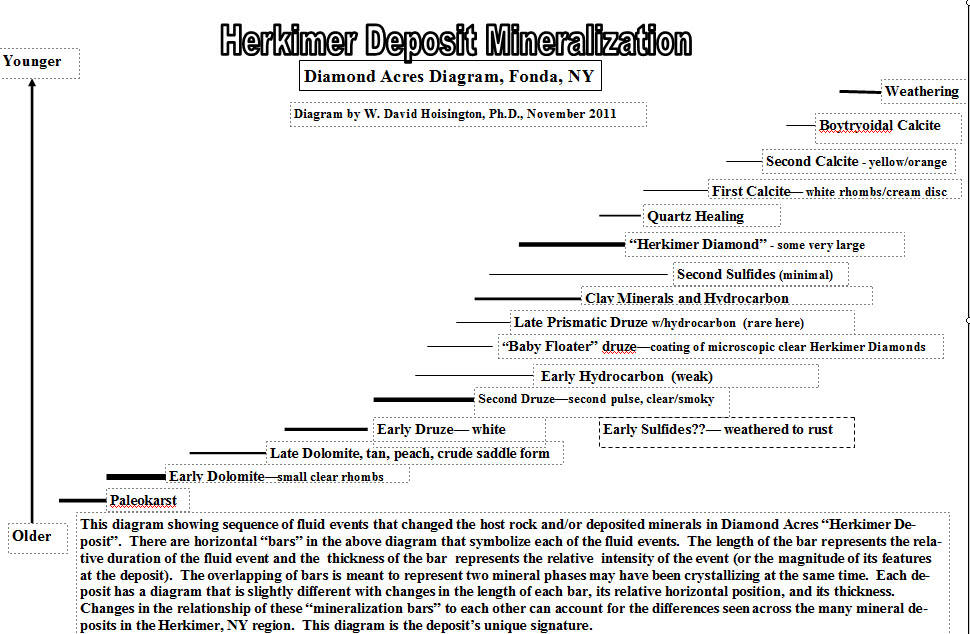
Diamond Acres is the area that this author has visited the most, going back to the early 1970's. More than 40 "pockets" of crystals have been discovered over the decades and several different mineral zones explored resulting in a large Herkimer collection. The examination of this collection gathered, plus many field trips to collect specimens looking for the "missing links", and the added wisdom from "old timers" interviewed, has resulted in the mineral sequence diagram below. There are also photo albums and resources for the collector wishing to go digging for "Herks" (to be added).
Mineral Sequence Diagram for DA
Comments on the mineral sequence diagram specific to Diamond Acres are below (research in progress).
Collecting Tips and Links
More information to be added.
W. David Hoisington, Ph.D.
Testing the new photo albums and the new mine site layout - August, 2011
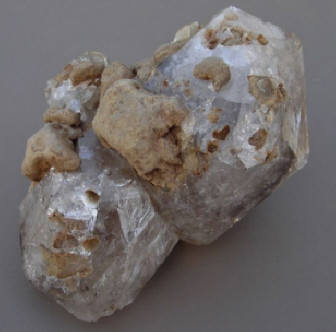
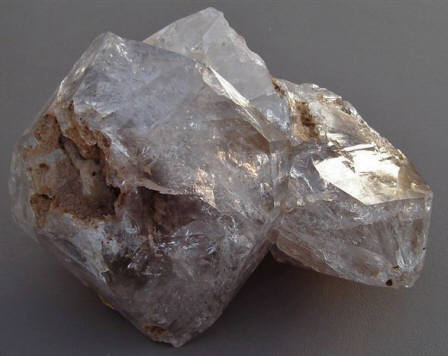
These are two photos sent in of a Herkimer crystal group specimen, locally called "goonies". What is nice about these two photos is that they show the "common" habit for the larger quartz crystals at this location - which are also unique to this location.
Notice the rounded off sandy dolostone on the photo to the left. Good evidence of weathering. (note --------------->
These pieces of rock are where the crystal made contact with the cavity in which it "grew" and thus encapsulated the wall rock. It is characteristic for this location. Thanks to Linda Grindstaff (2008) for both of the photos.
Note that there is a photograph, below left at the blue arrow, of a small protected "valley" in pocket wall rock that shows a little of what it might have looked like before weathering. Note the dolomite crystals. See also the dolomite page.
The photo on the right is the top view of the above specimen (which showed the bottom view). Note that the faces are mostly flat and shiny. The holes directly facing once had dolostone in them like shown in the above picture, indicating a contact with the host rock. The crystal contains many internal fractures creating "rainbows" and there are patches of smoky color. All these features are characteristic for this location - as is the size 10 inches along the length of the specimen! (25 cm)
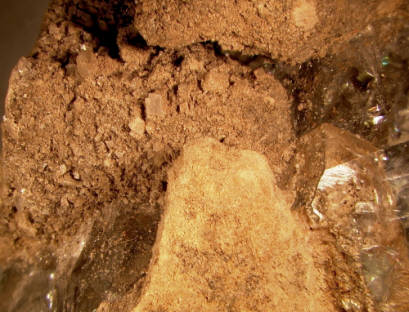

The photo to the left is of a different specimen, but still from a pocket containing these large Herkimer diamonds (the point of a crystal is shown on the right). Of all the Herkimer deposits, weathering effects are most dramatic at Diamond Acres. Yet it is likely the wall rock was, at one time, covered with crystals - similar to what we see in fresh surfaces at other mines. A hint of this is shown at the arrow where this sandy dolostone has a coating of crude dolomite crystals. Such examples of what the "original" wall rock in these large pockets might have looked like are not easily found at this location because of the weathering.
Specimen collected and photographed 2008, Dr. C.
This Herkimer diamond mine has a small fee for collecting. It also has areas where people have paid to "stake a claim". You may not collect on other people's claims without their permission.
The above diagram is an "estimation" based on field observations over many years. No detailed measurments (like thickness of quartz veins) were made. Comments for the above diagram are below, and photos can be found in the photo albums on this web page and on the mineral pages - click Other Minerals.
Comments on the Herkimer diamond photos:
Photo 1. Circle of "diamonds", reconstructed.
Photo 2. Rare champange group, reconstructed. There were two other specimens from this special pocket, all very clear and with the wisp of smoky.
Photo 3. Small Herkimer with baby floater inclusions, note the fragmented nature of these inclusions.
Photo 4. Excellent cluster of clear crystals, restored.
The paleokarst, and sabkha, event did have an effect on the host rock. Other than changing the porosity (holes in the rock) it is not clear if any mineral crystalization can be tied to this event.
First dolomite: This is likely the phase that changed the rock from limestone to dolostone. The crystals are small rhombs and at DA they are the largest in the district and visible with the naked eye.
Second dolomite: This is the "large dolomite" that occurs in some cavities at DA. It is often very etched. The common form is weathered or altered to a tan or light beige.
Early Sulfides: This phase is often of very small pyrite, marcasite but at DA it seems nearly absent. This may be because of heavy weathering at DA resulting in only a rust coating over near by minerals. Large pieces of limonite and geothite are known from nearby deposits, but none yet to be reported form DA.
Third dolomite: This also "large dolomite" that is rare at DA.
Early druze: This white druze, pyramidal, often forms the base for the later druze episodes. It is rare at DA.
Late druze: This druze doesn't form a thick rock contact, but it has a thin contact "rind". This druze is generally clear to smoky, pyramidal (little mountains). Often it has black inclusions and is the most common druze at DA.
Early Hydrocarbon: There appears to be an early hydrocarbon event that overlaps with both the late druze and the prismatic quartz events. Its intensity varies across DA giving rise to variation in the late druze.
Prismatic Phase: This phase includes both a druze and larger crystals but it is nearly absent at DA.
Hydrocarbon/Clay: There is a major hydrocarbon event that is in place before the Herkimer diamond event and is strongly evident at DA. The amount of associated white/pale yellow clay (not brown mud) is rare to find due to the heavy weathering.
Herkimer Diamonds: At DA there appears to have been a very strong Herkimer diamond event - probably the strongest in the district. What is absent are hopper crystals. Some skeletal features have been found.
Baby floater druze: This is a coating of small to microscopic Herkimer diamonds. It has almost no contact "rind" with the host rock. This druze is probably more common in the district than has been realized previously, but weathering has made it hard to find, especially at DA.
Second sulphides: These are basically needles of marcasite (iron and sulphur). Despite the intense weathering that turns these into rust, they are frequently preserved inside first phase calcite crystals as needle sprays and sometimes inside Herkimer diamonds.
First calcite: This is the most common calcite at DA. The difficulty is that the typical "nailhead" (disk shapped with 3 face on the top of the disk) form is very hard to find due to the intense weathering.
Second calcite: This calcite is easy to recognize once you have seen how different it is in from from the first phase calcite but is is rare at DA. It occurs as small clusters and fans of crystals ranging from white to amber.
Third calcite: This is not easy to recognize until you see it for the first time. It occurs a rounded bumps and it can be as a coating over any earlier mineral. But at DA it is very weathered and very pitted, nearly unrecognizable.
There is a final weathering event that has, in some places, severely altered the minerals listed above.
Quartz Healing: This is an event that may have been strong at DA, turning all hopper crystals into "healed over" Herkimer diamonds (just a theory, as more evisence is needed).