Best Website for Herkimer Diamond Information
Last Updated:

About this Webpage:










Free Website Where Herkimer Diamond Enthusiasts Share Information with the Public
Scroll down
Dr.C. did two talks at the Herkimer Diamond Festival (July)which are in a Youtube movie. The research on the Herkimer District is in need of samples and photos.
How can you help? Visit the "how to help" page.



The "Baby Floater" Stage - The Oil and Seed Crystal Theory for making Herkimer Diamonds
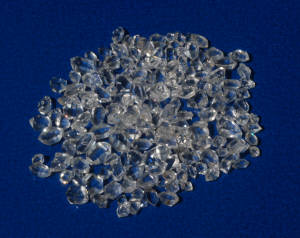
Although not discussed much, the pockets which contain Herkimer diamonds often contain many very tiny Herkimer diamonds. These frequently can be found to apparently have no growth contact points. It seems they were "floating" in some fluid when they crystalized. These tiny Herkimer diamonds have been found as inclusions "floating" within larger Herkimer diamonds and also "floating" within fluid inclusions as detached crystals. They can also be found as a unique looking druze coating, here termed "baby floater druze". These baby crystals probably acted as "seed crystals" for the larger Herkimer diamonds. This is the "Seed Crystal Theory" part of the Oil and Seed Crystal Theory of Herkimer diamond formation.



W. David Hoisington, Ph.D.




Variations of the Baby Floater Inclusions

The Baby Floater Druze

June, 2012
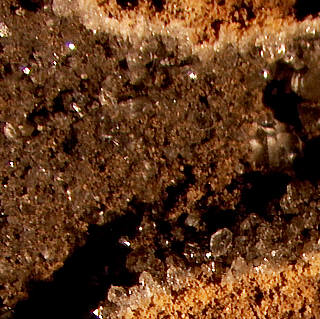


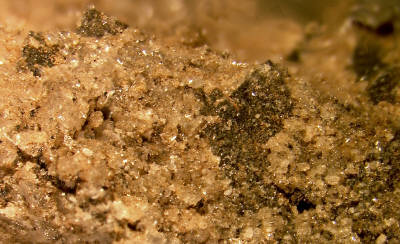
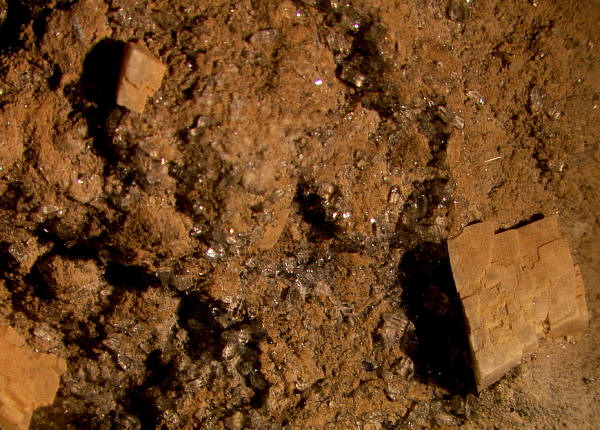

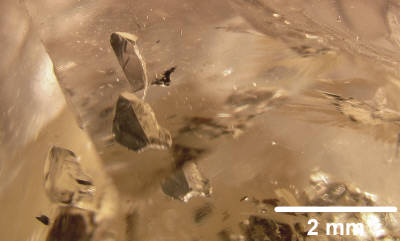
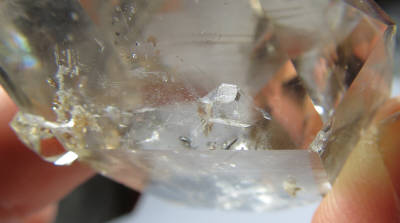
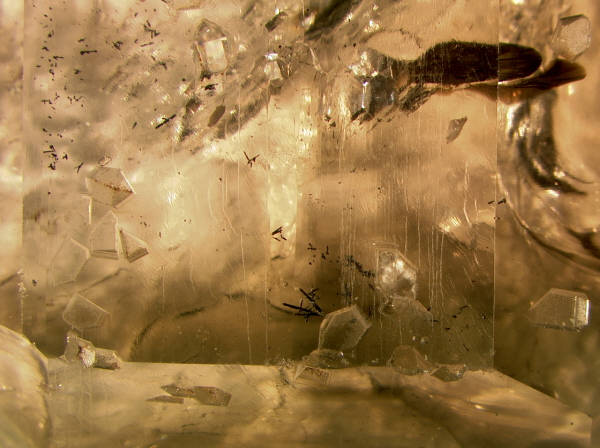
One of the most common form of the "baby floater" stage is as fragments. In many of the crystals that come from hydrocarbon pockets it is common to see these as inclusions. Note above the jagged edges and the incomplete crystal form of the inclusions.
There are more of these fragment type baby floater inclusions shown in the photo below. You can tell that you are looking into a larger crystal because you can see a face edge on the right and face striations running down the center.
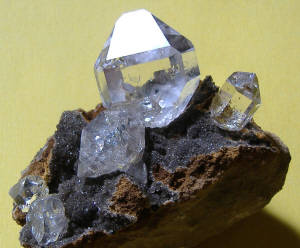
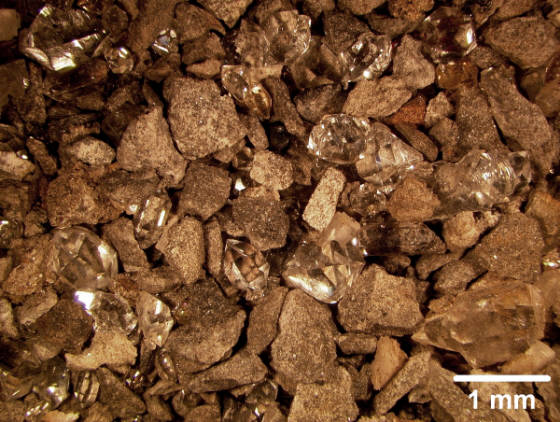
Like with other examples of the baby floater druze, there is alteration of the rock, an etching of the previous druze, and the baby floater crystals are not in any parallel growth pattern like other druze but instead are just sprinkled about.
The microscope photo on the left shows a light coating of microscopic Herkimer Diamond like crystals on an "eroded" matrix. The blocky crystals are dolomite. From Herkimer Diamond Mine, Middleville, NY. Photo, Dr. C. The largest dolomite is only 2 mm across and has more of a peach color in natural light.
This rock, called pocket wall rock, seems to be fairly common for Herkimer diamond pockets from this mine.

The Baby Floater Episode - Conclusions
Below is a citrine clear crystal, 7 cm long, that has many "baby floater" contacts showing a number of different features. Close up is on the right. Fonda, NY (DA), a unique champange crystal pocket, Mike Hoisington, 1972. Photo by DrC. 2008.
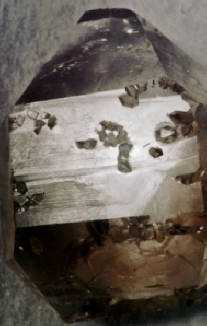

The above evidence suggests that the baby floater event came after the early druze and before the major Herkimer diamond event. It also appears that the baby floater event had a strong effect on the host rock, creating alteration features that look like what would happen if heated corrosive fluids entered the rock. But perhaps the most significant impact of the baby floater event was its role in providing "seed crystals" from which the larger Herkimer could grow. This is called the seed crystal theory for Herkimer diamond formation.
The seed crystal theory is pretty simple. It proposes that there were very tiny Herkimer diamonds floating, in solution, in the fluids that eventually helped to make Herkimer diamonds. These tiny Herkimers diamonds acted as "seeds" for the growth of larger crystals. It was probably a critical part of how Herkimer diamonds were formed.